01 January 2022

The Island of Asteria


The Holy Island of Asteria

This sacred island in the Meridean Sea takes its name from Asteria, sister to the Blessed Latona. It was Asteria who had Trioditis by the Titan Perses, the Destroyer.

The Titaness Asteria, the Starry One

When Asteria disobeyed God the All-father, and rejected his proposal, she flung herself into the sea. She fell from the heavens as a shooting star and plunged into the ocean where she turned into an island that floated on the waves. And that island took her name.

Later, when her sister Latona had conceived with God, but was forbidden to labour on earth, Latona voyaged from Hyperborea to the island of her sister to give birth (as it was a floating island, and deemed to be not on earth). And it was there that Our Lord Carneius and His sister, Saint Orthia, were born.

The Birth of Carneius and Orthia on the Island of Asteria

Later, this sacred isle became the site of heresy, known as the Brizonian Heresy. To this day,  a heretical community of women there believe that Asteria (whom they call, Brizo) is a holy saint who prophesies to men via their dreams. As part of their heresy, they also believe that when Latona came to their island to give birth, she was accompanied by wolves and that, as a result, wolves are sacred to Lord Carneius.

But of course this is wrong. When in 2579 A.T. Hierophant Singara IX issued his bull declaring that all magic was done with the aid of Trioditis and her demons, Asteria, as her mother, was removed from the church's calendar of saints.


26 December 2021

Eleventh Moon: the Gracemoon


I haue a gentil cock,
Crowyt me day.
He doth me rysyn erly,
My matyins for to say.

The eleventh moon, the Gracemoon, has 31 dawns. It is named for the grace shown by Our Lord Carneius in bringing us safely through another winter. 

This is a moon of gentle warmth that awakens passions. Leaves sprout and flowers blossom. The air is filled with birdsong, especially that of the nightingale.

When the nightingale sings,
The trees grow green,
Leaf and grass and blossom springs!

The hunting season resumes with this moon: especially for our nobles, who return to their falconry during this moon.


The Feast of the Nativity

The 24th and 25th dawns of this moon see another of the great quarter days of the year: the Feast of the Nativity of Our Lord Carneius and Saint Orthia (or, the Feast of the Nativity, for short). 

The festivities begin with the first Sunday before the 24th dawn, known as Fig Sunday, which marks the first return to farming the land. The first-fruits of the earth are blessed in a token of thankfulness to Carneius for His grace in providing for our sustenance (hence, grace-moon). And prayers are offered to Him for the bestowal of His grace for a successful farming summer to come. The clerics bless fig branches for the common folk, who then hang them from the doors of their homes to ensure a fertile summer to come.

It is also the time for paying of the tithes to Mother Church, making it the most important moon for the Church's coffers.

Servile work is traditionally forbidden during the Nativity. Instead, the common folk throughout Hellot often hold Fig Fairs, with much ale, and dancing, and musical contests in celebration of Carneius. Some such fairs can turn riotous with excessive drink and many vagabonds.

A Fig Fair!

While the law courts do not sit during Fig-tide, there is an ancient custom adhered to in many parts of Hellot whereby those condemned since the last Nativity of treason, heresy, sorcery and crimes against nature (such as sodomy or bestiality) are taken out to a Fig Fair to be burned or to be thrown from heights to their deaths. On their procession to their place of execution, an old custom is for spectators to beat the condemned with fig branches.

Burning criminals at Fig-tide!

It is not unheard of for kin of the condemned to attempt unlawful rescues, or to hire mercenaries to effect the same, often emboldened by ale.


24 December 2021

Seventh Moon: the Kyngsmoon


The seventh moon of the year is a midwinter moon of 31 dawns. It is named in honour of King Theseus.

It is a cold, melancholy and frosty moon. Many folk spend their time baking bread during this moon; collecting firewood in the bare forests; and slaughtering their swine. The wealthy often hunt boar in the thick and misty woods.


The Feast of the Translation

One of the four great quarter days occurs during this moon: the Feast of the Translation of the Relics of Theseus (or, the Feast of the Translation, for short). It is celebrated over 12 dawns, beginning on the longest night of the whole year: usually after the third dawn of Kyngsmoon. The feast has been observed since 735 A.T. and marks to return of the relics of Theseus to the Parthenion in that year.

The Parthenine general Coalemus received a prophecy from Lord Carneius that the bones of King Theseus were interred on the Island of Dolopon. Theseus had sailed to his estates on this island after being deposed from his throne in the Parthenion in 21 R.T. But the local king, Lycurgus - fearing that the charismatic Theseus might usurp him - had Theseus thrown from a cliff to his death.


Some seven centuries later, Coalemus took an expedition to that island, conquered the local inhabitants, and then scoured the island for Theseus' remains. He found a tomb containing the bones of a gigantic man and a mighty bronze sword. These he translated back to the Parthenion, and interred them in a magnificent tomb in the heart of the city: the Theseium. This tomb thereon served as a sanctuary for the defenseless and the oppressed of the world. The relics are closely guarded, not only for their holy significance, but also for the sacred and mighty properties of the sword of Aegeus.

The Theseium

Even to this day, an important part of the Feast of the Translation is donations of bread and meat to the poor, which thus is for them a feast at which they feel no want and might fancy themselves equal to the wealthiest citizens. Folks of all stations stop work, decorate their homes, and feast merrily. 

Merry Translation!

23 December 2021

The Reckoning of Hellot


Much of Hellot uses the Ancient reckoning of the passage of time.

This begins with the reign of King Theseus, and his unification of the Ancient lands of Cecropia under Parthenine rule. The counting of summers in this period is abbreviated, R. T, for Reign of Theseus. His reign lasted 29 summers.


King Theseus


After his deposition, the reckoning is noted as After Theseus (A.T). Thus...

  • the War of Ilion raged from 11 to 21 A.T. 

  • Acmon founded the Agrinium in 22 A.T. and Chionopolis in 55 A.T. 

  • The Emperor Crinos was born 1105 A.T, and the famed Ancient architect, Neson, circa 1270 A.T.

  • the Road of Crinos was built between 1166 and 1169 A.T.

  • Neson completed the Bridge of Homados in 1309 A.T.

  • Sir Jade the Bronzfoot was born 2496 A.T.

  • the Battle at the Pass of the Batelbrygg (Homados) was fought in 2559 A.T.

  • the prolonged war between Rûna and Zarya began in 2762 A.T.

Summers before the Reign of Theseus are recorded as Before Unification (B.U). Thus...

  • the mighty Ilion began as a mere village around 1700 B.U.

  • Cecrops, the first king of the Parthenion, reigned from 322 to 272 B.U. 

  • Acmon, hero of the war of Ilion, was born in 9 B.U. 

A new summer begins when the Sun is at his highest point in the sky...

20 December 2021

Battle of the Paps of Deana


The Seven Paps of Deana

In the summer of 2558 A.T, a deed of arms occurred in the region of Uberia, near one of the rude memorials of the aboriginal inhabitants of Chalace. It was a circle of Druidical stones vulgarly called, The Seven Paps of Deana. Some clergy claim this Deana is our Saint Orthia, and hold the site to be a holy one.

Olek Onisimov, a courageous man-at-arms, was captain of a company of the renowned horsemen known as Rygar's Riders. He commanded around a score of lances who went marauding through Zarya and Chalace and advanced as far west as the Wreck of Erbourg. They held merchants passing through these lands in the grip of such fear that none dared to venture out except with great stealth. This angered the knights and squires of Erewhon and they resolved to find a solution to the best of their ability or else be killed or captured by their enemies in the fields. They gathered and assembled around two hundred lance in the Harpyian Heath, since it was the region Onisimov and his troop most often harassed. From Erewhon there were Sir Laur von Folsberg, the fierce sergeant Fridl Fraidenberger, and many others who were eager to meet their enemies. Through their spies these captains knew that Onisimov was riding towards Erewhon on the hunt for loot.

Accordingly they got themselves ready as well they were able and set out along the road of Crinos, all well armed and mounted. Upon one dawn, Onisimov and his company arrived near a great stretch of bog and marshland through which ran a stream called Dianbec. Above the bog, on a rise of grassland, stood the Stones of Deana. From the road nearby the Erewhonais appeared and advanced on their wing with more than two hundred lance; Onisimov's troop were taken completely unawares. The Erewhonais charged at their enemies with all speed, lances raised, and the first assault brought many of them to the ground. It was a fierce encounter and a hard battle which went on for a long time, for they were fighting hand to hand and violently thrusting their lances wherever they touched, until they were out of breath. Many great deeds of arms were performed there. Finally, the Erewhonais gained ground; Onisimov's troop were defeated and all killed or routed, and Olek withdrew alone into a bog.


There the enemy fell on him, shouting, Death to him! When he heard those words, Olek waded back through the Dianbec to his enemy, and he drew the fine, long sword of his grandfather, called Donarsdin, or Thunder Clap, forged of a fallen star. Olek glared at his foes furiously, shouting, Wild flash split abroad the thunder-crash! Then there was thunder most horrible, and Olek began to skirmish and open up a space around him.

It was a great spectacle to behold and none dared approach him. Some of them advanced, but with each blow he rained down on them he cut off a foot or a head, an arm or a leg. There were none so brave as to be unafraid of him, and there in the water Olek Onisimov performed so many marvelous feats of arms, but there were over two hundred of those scoundrels. They threw and launched objects at him and he was completely disarmed. Yet he had killed twelve of them outright, not counting those whom he maimed and wounded. Finally Olek was brought to the ground; his legs and arms were cut off and they dismembered him a piece at a time. That was the end of Olek Onisimov, which was a great pity, and all the host of Rygar were deeply enraged when they heard the news.

Olek's head had been struck off in the fray, and Sir Laur had it carried to Zarya and sheathed in molten gold, and presented to Olek's son, Velibor. But the other pieces of Olek's body Sir Laur had laid to rest in the centre of the Seven Paps, and his great sword, the Donarsdin, was interred with him. Then obsequies were performed there with as much reverence and honour as if Olek had been von Folsberg's own son.


Donarsdin


30 December 2011

the legend of Ganatra the Great

"
Ganatra the Great
For it so happens, as well you know, that when people are overcome by the sorrows of their thoughts that they desire only to dream. Thus the Lord God who loved Ganatra made him fall to sleep for this is His pleasure. And his faces were like a rose which opens at dawn as he lay on his side.
" Thus begins the legend that the last king of Chalace lies asleep under the Snomont, awaiting a time when his former kingdom is in great peril.

Ganatra the Great was born in 1949 A.T. The Ancients called him Kanatros Magnos, while the elves called him Carnatramōn. He was crowned King of Chalace in 1973 and then in 2005 the elfin court entitled him Emperor of Peace (as the elves were also known as, 'the People of Peace'). To them, he was their greatest ruler and protector. He drove from Chalace all the dark and evil things, and treated with the Menfolk to leave the elves in peace. He died in 2019, but the elves believe that he lives still, deep under Snomont, ready to rise again and aid the elves in their greatest need.

29 December 2011

Bileth the demon king


Bileth is a great and terrible king of demons, riding on a pale horse, before whome go trumpets, and all kind of melodious musicke. He is of the orders of powers, hoping to returne to the throne of Malebolge, which is not altogether credible, and he ruleth eightie-five legions. His Noble Badge is this, which is to be worn by those that serve him.

the badge of Bileth

the folly of King Salmoneus

from the book of Vigidotus, a tale of the Ancient times:
Wicked King Salmoneus of the Barbarians

We shall endeavour to set forth the facts concerning wicked Salmoneus. He was a son of Aeolus, God of the Winds. He founded a city in Hyperborea on the banks of a river and called it Salmonia after his own name. And by his first wife he begat a daughter, her who was given the name Tyro, a maiden of surpassing beauty. She loved a river, the divine Enipeus, who flows from Mount Othrys, occupied by the Titans.

Salmoneus, being an overbearing man and impious, came to be hated by his barbarous subjects. In his mockery of the gods he would celebrate neither sacrifices nor festivals in their honour, as the other rulers were accustomed to do. He made it his practice to ridicule the divinity and to declare that his achievements excelled those of Zeus; and he took away the sacrifices of the god and ordered them to be offered to himself.

Consequently he used to make a tremendous noise by dragging behind his chariot dried hides stretched over bronze kettles, and thereby he said that he thundered more loudly than Zeus, and by flinging lighted torches at the sky he said that he lightened. Borne by four horses, he rode triumphant through his city, claiming as his own the homage of deity, saying that he was himself Zeus.

Madman, to mimic the storm clouds and inimitable thunder with brass and the tramp of horn-footed horses! But the Father Almighty amid thick clouds launched his bolt, wiped out the city impious Salmoneus had founded with all its inhabitants, and drove him headlong with furious whirlwind into the pit of Tartaros. Being arrogant and wishful to put himself on an equality with Zeus, he was punished for his impiety.

Far below, where the uttermost depth of the pit lies under earth, where there are gates of iron and a brazen doorstone, as far beneath the house of Hades as from earth the sky lies, wicked Salmoneus is broken alive on the wheel, and exposed thereon, while Tartaros stands deeply about him.
being broken on the wheel

24 December 2011

multi-classed characters

In the Hellot campaign, only half-faeries and hobbits are permitted to be multi-classed player characters.

The multi-classed character does not advance as quickly as his fellows.  Experience points are divided equally among all classes held, even if the multiclassed character can no longer advance in any class. The division of experience points between classes continues even after the advancement caps are reached in any one of them.  Thus a hobbit fighter/thief, who is limited as a fighter but not as a thief, will continue to lose half of his earned experience to the capped fighter class, advancing more slowly as a thief than a single-classed thief would.

Multiclassed characters advance in each class independently, and therefore train in each class independently.  They will receive separate grades for each class, and be charged time and money separately for each class upon advancement.  The multi-classed character must perform functions of each class on each adventure in order to keep the grades high (and the commensurate costs and time of training low).  This is in addition to expenses for upkeep, such as armour and weapon maintenance for fighter classes and spell components for mage classes.


With a triple-class combination, advancement is extremely slow and hit points are not very strong.  With fighter/mage/thief, for example, the character is restricted to the armour of the thief for the performance of thief functions, but not to magic-user armour restrictions. 

If a race is limited in advancement in any stated class (by race, not by the maximum level possible for the class), the maximum level for the multi-classed character is two levels lower than the advancement limit. For example, a stoor hobbit (stout halfling) if multi-classed as a fighter/specialist mage could advance to fighter to level 5 (normally level 7 if not multi-classed; higher levels available for higher strength:  F8 for St17, F9 for St18(50), F10 for St18(90), F11 for St19) and mage to level 7 (normally level 9 if not multi-classed; higher levels available to higher intelligence:  M10 for In18).

In regard to weapons and armour, the character may use any weapons and any armor permitted to any class held.  Thief functions, however, may not be performed while in armour inappropriate to the thief class, and magic-using classes may be limited in relation to performing magic while in armour, although some races are not so limited.

Multiclassed characters have proficiency slots for all their classes. All these slots are not lumped together, however; they remain separated by class. A fighter/thief, for example, who chooses to attack as a fighter suffers the fighter nonproficiency penalty if he uses a weapon with which he is proficient only as a thief. Likewise, the fighter/thief may only back-stab with a weapon allowed to the thief class.

A half-faerie converses with a hobbit
Half-faeries:
Cleric/Fighter
Cleric/Thief
Fighter/Thief

and with permission:
Cleric/Specialist Mage
Cleric/Ranger
Fighter/Specialist Mage
Fighter/Specialist Mage/Thief
Specialist Mage/Thief
Druid/Fighter
Druid/Ranger
Druid/Thief
Specialist Mage/Ranger
Cleric/Fighter/Thief

Hobbits:
Cleric/Fighter
Cleric/Thief
Fighter/Thief

and with permission:
Druid/Fighter
Druid/Thief
Fighter/Specialist Mage/Thief

15 December 2011

arms of the Night Witch

The coat of arms attributed to the devilish Night Witch.
Scarlet is the distinctive colour of the Night Witch, and the owl and moon are symbols associated with her from ancient times. The bar wavy in base alludes to the river Styx, as the Night Witch is believed to make her home in Hell, where she is ranked as a princess.

09 December 2011

convictions of the Faithful of the All Father

Following is a list of common convictions held by those who worship the All-Father in Hellot.
Knight of God
  • I must obey the priests of God.
  • You can never challenge the will of God or his priests.
  • You must always obey the law of the city you live in.
  • Humiliating a defeated opponent is immoral.
  • Stealing public or sacred property is a sin.
  • To make yourself a better man, you cannot treat someone else poorly.
  • I will always defend the priests and churches of God.
  • A man must always respect the nobility.
  • I serve my superiors with loyalty.
  • Disobedience leads to anarchy, which leads to sin.
  • Never show mercy to a selfish or cruel opponent.
  • Too much freedom is against God's will.
  • You must never run from your enemy.
  • A real man never tolerates an insult.
  • Always be generous to strangers and guests.
  • By becoming powerful and famous, a man praises God.
  • Sorcerers must never be trusted.
  • Orders must be obeyed.

07 June 2011

the Silat

No appearing: 1 (10% 2-5)
Armour Class: 3
Move: 90' (150')
Hit Dice: 8+1
% in Lair: 15%
No of Attacks: 3
Damage/Attack: 2-8/1-4/1-4
Special Attacks: 1x/rnd lightning bolt (dmg 8-48); 6x/day Otto's irresistible dance; 3x/day mass charm (as 18th level)
Special Defence: 1x/day invisible
Alignment: Chaotic
Size: L (8' tall)

Once per day they can use the following spell-like abilities: detect good, detect magic, misdirection, invisible and wish.

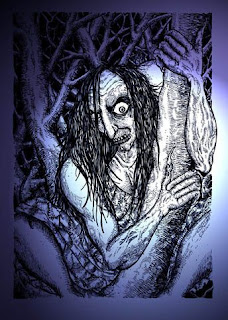
Silats are witch-like shaitan jinniyah who live in forests and delight in fomenting conflict. They have bluish-purple wrinkled skin with large, round, white eyes; long pointed noses; hunched backs; a lion's tail and paws; and a gibbering mouth full of fangs.

05 June 2011

Wieder Werzier, master mason

Wieder Werzier is the most influential mason in southern Erewhon. He was born into an active family of masons, who were originally of Zaryan stock (where the family was known as Verzir).
Wieder Werzier (b. 1536 A.T.)

His technique is strongly rooted in the Erewhonais tradition, but is also influenced by Fellandish Hudian. As an architect of the Radiant style, his works exemplify the tendency to profuse ornamentation and the technical ostentation characteristic of the late Hudian style. He enjoys complicated vaults with hanging bosses and ribs rising free through space. He has originated the first real net vaults in Hellot.
Werzierian net vault

14 May 2011

Allowable PC Classes & Races

Fighter
Paladin
Mage/Magic User
Psionicist

Cleric
Thief

only with DM approval
Barbarian 
Ranger 
Druid  
Bard
Specialist Mage/Magic User
 
Races
Men (Humans)
Hobbits (Halflings)
Half-faeries, or Mortal Men raised by Faerie

Caerllew


In the fourth century, this castle, and the settlement surrounding it, was known by the Kravs as Lûvberg, or Leuburg. It has a long Northmen history. Sargon ‘the Wizard’ built the castle. It stands two days march north of Streel River in Maeland.

Sargon built this castle over two-
thousand years ago as the focus of dark rites. He was said to be in league with Hell.


front elevation of the castle of Caerllew

Rygar's Riders

Little is known about this free band of several hundred horsemen, lead by their captain, Rygar.
They are the remnants of the Host of Zar, defeated by the Bronzfoot’s forces in 2560 A.T. They harass trade along the Road of Crinos, and seem to pour forth from the Hobfen or the Foggwood.
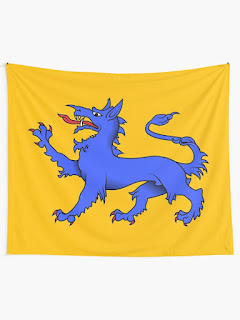
The golden banner of Rygar


letter from Werzier to Jade

Unto His Grace, the Duke of Dothasse, Earl of Penthuer and Nakkueneda, Marquis of Alethnea.

My Lord Duke: it is with pleasure I write from Your Grace’s new lands and may I take this opportunity to again congratulate Your Grace on the procurement of an array of noble titles. Might I also say a right and proper start to a life of nobility hath been made by choosing to hire the best Master Mason in all of Hellot to design your Grace’s palace. I pen this missif from the banks of a cool river north of the main Schallass road, in a land the local boy here calls Nakke Penthuer, or more simply, Penthuer. Through my Zargrad man, Feidir, who speaks both the tongues of this peculiar boy and of the Felinish, of which latter language I myself have an understanding, I am told Nakke Penthuer means Steppe-land of Thorns. But I have yet to see a single thorn tree, and so strikes me this an odd name.

Indeed what a pleasant land doth lie about me here. The valley is broad and beautiful with a pleasant spring air. The river rushes with a most soothing tone. Gently rolling plains, covered in long nodding grasses, spread as far as my eye may see in all directions but west. The west, at the bottom of a sharply falling scarp, be a swampy land of a different nature. Yet here, on this broad plain and in this pleasant valley,  the earth is good and charming yellow poppies and primroses grow happily in plentiful bunches. 

Feidir, who gladly informs me he was a farmer before a trader and trapper, claims the soil is rich and good for grains. And the boy, Alkioth he is called, can attest for his family he claims wrests ample living from this land. I have noted several old copses of deep shaded beech and hard-beam trees. They would make good heavy lumber for any building your Grace might wish in these pleasant parts. Yet by far the predominant trees are young, quickly growing ash and pine. Fine tool handles could be fashioned from the former and resin from the latter put to use for caulking and lamp oil. Alkioth the boy, who claims to be the nephew of a local lord unknown to myself, tells us this land, the Earldom of Penthuer, is bound in the north by a river and by another river in the south. The eastern  border doth lie at the entrance of the Fogge forest, growing at the base of a cluster of mountain peaks I see from here. To the west, the Earldom is bound by a massive scarp the boy calls the Ridge of Elaenn.  When I enquire who the lady Elaenn is I am told she was a queen who lived far to the north, where the great mountains meet the sea. Feidir guesses this must be a land he knows as Wassa.  

W. Werzier


Catechism of the All-Father


I.                     Thou shalt believe all the teachings of the oracles and priests of the All-Father, and those of His prophet Carneius, and shalt obey all their commandments.

II.                   Thou shalt defend the priests of the All-Father and the churches and shrines erected in His honour.

III.                  Thou shalt respect all nobles and perform scrupulously thy feudal duties, if they be not contrary to the will of God, Lord Supreme.

IV.               Thou shalt make war against Chaos and the enemies of God without cessation and without mercy.

V.                 Thou shalt not recoil before thine enemy.

VI.               Thou shalt never permit thy reputation to be sullied.

VII.              Thou shalt love thy sovereign.

VIII.            Thou shalt be generous to strangers, and give largesse to guests.

IX.               Thou shalt not, in the name of Zeus Ephestios, steal from the city of which thou art a citizen, nor covet thy neighbour’s house.

X.                 Thou shalt everywhere and always seek power and glory.

Dedicate oneself to the Code. Oppose Chaos and its minions. The ultimate harmony of the world rests upon law and order.


the Trow

A trow dancing the Henking

Frequency: rare
No appearing: 1-8
Armour Class: 5
Move: 90' (30')
Hit Dice: 3 +3
% in Lair: 50%
Treasure Type: C
No of Attacks: 3
Damage/Attack: 1-4/1-4/1-6
Special Attacks: cause disease
Special Defence: teleportation
Magic Resistance: standard
Intelligence: low
Alignment: Chaotic Evil
Size: S (5' tall)
morale: 7

The Trow, which is a variety of bogle and a relative of the troll, is a gnarled, little night monster that delights in kidnapping human children and inflicting disease.

They are active only during the night, when they sneak silently about looking for mischief. The Trow has excellent infravision (90') and a very acute sense of smell, which allows it to detect invisible creatures without fail.

These bogles will normally sneak into a home, kidnap any children present, and infest the rest of the family with disease. This ability takes the form of a cause disease spell, which a Trow may cast once per day. If  Trow is surprised, it will do its best to escape and return to its subterranean home. If cornered, it will fight its way out with its claws (1-4 dmg) and teeth (1-6 dmg). Similar to the troll, the Trow is able to regenerate lost hit points at the rate of one per round.

The Trow live in secret, underground lairs, the entrances to which are hidden and only accessible by a teleport spell, which the may cast twice per day. If a Trow does not return to its lair by daybreak, it will turn into an old, gray hag and must wander about until darkness, when it may teleport home. In this state it loses all claw attacks, and its HP are reduced to half.

The Trow usually dwell near remote, wilderness settlements, but large numbers are occasionally known to inflect cities. They are thieving cowards outside their lairs, but very aggressive when inside them. Their social organisation is loosely tribal. These bogles enjoy feasting on the boiled flesh of young humans (they find adults too tough) and can often be seen dancing their bizarre, lopsided dance, called the 'Henking', on moonlight moors.

The Trow dress in whatever rags they can find. Their long, unkempt hair is dark and greasy, while their skin is dry and gray. They have small, beady eyes, large noses and ears, an over-sized head and hands.